Junior and Youth Goalie Skates for Developing Players
Junior and youth goalie skates are designed around the smaller feet and developing skating mechanics of younger goaltenders. They provide the blade contact, support and protective construction required for goalie-specific movements such as lateral pushes, butterfly recoveries, post integration and controlled movement around the crease.
A properly fitted goalie skate should hold the heel and foot securely without creating painful pressure points. The child should be able to bend through the ankles, maintain a balanced stance and engage the blade without the foot moving excessively inside the boot.
The Goalie Crease carries junior goalie skates from Bauer, CCM and TRUE. Current options include recreational and value-focused skates, performance-oriented traditional boots and Bauer’s buckle-based KONEKT design.
Compare Junior Goalie Skate Models
Depending on current inventory, this collection may include:
- Bauer GSX Junior goalie skates
- Bauer Elite Junior goalie skates
- Bauer KONEKT HF3 Junior goalie skates
- CCM EFlex 6.9 Junior goalie skates
- TRUE Catalyst 5X4 Junior goalie skates
- TRUE Catalyst 5X6 Junior goalie skates
Available sizes and widths can vary between models. Fit should take priority over brand, price or appearance because each boot can wrap around the heel, ankle, instep and forefoot differently.
Bauer GSX Junior Goalie Skates
The
Bauer GSX Junior goalie skate
is designed for newer, recreational and developing goalies looking for a comfortable traditional lace-up skate.
Its fibre-composite quarter package uses Bauer’s STANCEFLEX construction to provide a more forgiving feel and support forward flex in the goalie stance. The deeper-fitting boot is designed to wrap comfortably around the ankle, while a comfort-edge collar helps reduce irritation around the top of the skate.
The GSX also includes a lightweight outsole, comfortable liner and traditional skate tongue. Bauer pairs the boot with its VERTEXX EDGE goalie holder and LS1G+ steel.
The Bauer GSX may suit a young goalie who needs dependable support and comfort without the stiffness or price of a higher-performance skate. It can be a practical option for house-league, recreational and first-time full-season goalies.
Bauer Elite Junior Goalie Skates
The
Bauer Elite Junior goalie skate
provides a more performance-focused traditional skate for competitive developing goalies.
Bauer combines a lightweight VERSACOMP quarter package with STANCEFLEX PRO construction to provide a balance of support and forward movement. A digitally printed outsole creates a firmer platform beneath the boot to help transfer energy during pushes.
The Elite tongue is designed to reduce lace pressure, while additional ankle padding and a comfort footbed support the foot inside the skate. The boot is paired with Bauer’s VERTEXX EDGE holder and LS3G+ runners.
The Bauer Elite may be appropriate for a competitive junior goalie who practises and plays frequently and wants a lighter, more structured traditional skate than the GSX.
Bauer KONEKT HF3 Junior Goalie Skates
The
Bauer KONEKT HF3 Junior goalie skate
brings Bauer’s KONEKT concept into junior sizing.
Unlike a traditional lace-up goalie skate, the KONEKT uses buckle closures and a highly adjustable boot system. The design is intended to provide a close, consistent connection around the child’s foot and ankle while supporting additional forward flex in the goalie stance.
The KONEKT design may appeal to goalies who want a highly connected fit and an alternative to traditional skate laces. The buckle system can also make it easier to reproduce a similar level of tightness each time the skates are worn.
Because the KONEKT relies heavily on proper shaping, adjustment and buckle placement, it should be fitted carefully. Parents should not select a larger KONEKT simply to create several seasons of growing room.
The Bauer KONEKT HF3 may suit a competitive junior goalie who wants the flex and connected feel of the KONEKT platform in dimensions made for smaller feet.
CCM EFlex 6.9 Junior Goalie Skates
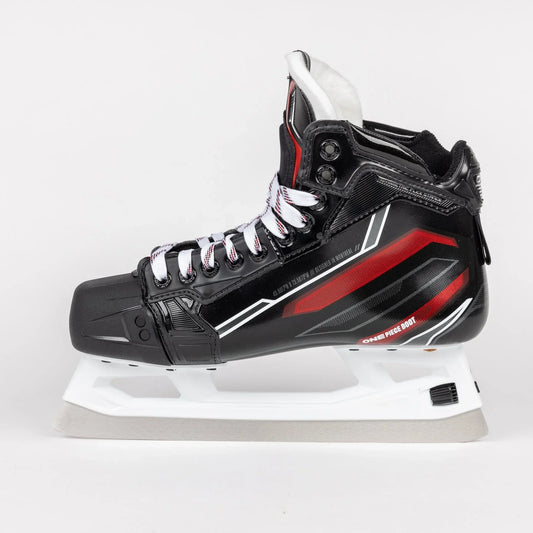
The
CCM EFlex 6.9 Junior goalie skate
uses a one-piece boot and lower-cut collar intended to provide direct energy transfer and increased ankle mobility.
Its RFM composite-blend shell creates a close connection around the foot, while CCM’s asymmetrical flex stance uses a lower boot collar to support deeper forward flex and agility.
A seven-millimetre felt tongue provides comfort and lace-pressure protection. The TOTALDRI PRO liner helps manage moisture, and a moulded CCM Ortholite footbed provides lightweight support beneath the foot.
The skate is equipped with CCM’s Speedblade XSG goalie holder and three-millimetre steel using a 10F27 profile. This profile is intended to complement a forward-leaning goalie stance.
The CCM EFlex 6.9 may suit a developing or competitive goalie who prefers a lower-cut boot, deeper ankle flex and the connected feel of one-piece construction.
TRUE Catalyst 5X4 Junior Goalie Skates
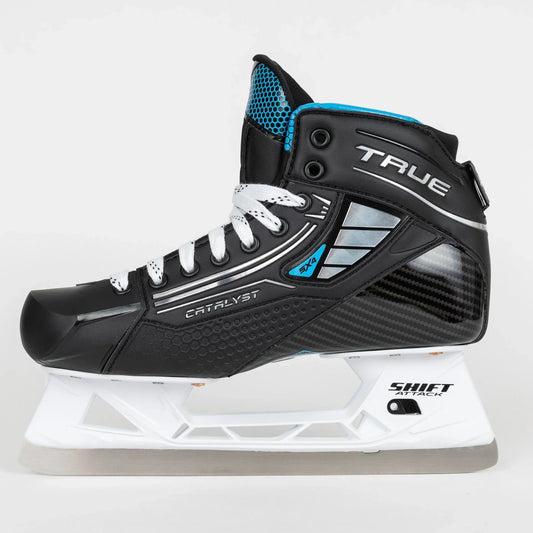
The
TRUE Catalyst 5X4 Junior goalie skate
uses TRUE’s NEUROFIT injection-moulded nylon-composite shell to provide a supportive and durable boot for developing goalies.
Stainless steel rivets help secure the holder, while additional shell layering provides impact resistance. TRUE’s Postlock feature is designed to help the goalie connect with the post and push away from it with control.
A Clarino liner helps hold the foot securely and manage moisture. The lightweight laminated tongue supports comfort over the top of the foot, while protective side panels improve resistance to wear in high-contact areas.
The Catalyst 5X4 uses TRUE’s Shift Attack goalie holder and three-millimetre steel. It may be a strong value for a goalie whose foot shape fits the TRUE boot securely.
TRUE Catalyst 5X6 Junior Goalie Skates
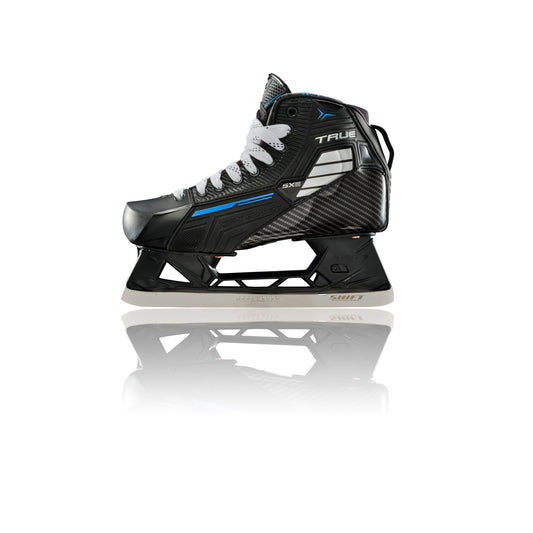
The
TRUE Catalyst 5X6 Junior goalie skate
is the updated generation of TRUE’s junior 5X goalie skate.
It continues to use the NEUROFIT injection-moulded nylon-composite shell, stainless steel rivets and reinforced shell construction. The Postlock feature helps provide a defined surface for post integration and controlled pushes away from the post.
A Clarino liner supports foot retention and moisture management, while the laminated tongue and abrasion-resistant side panels help improve comfort and durability.
The Catalyst 5X6 also uses TRUE’s Shift Attack holder and three-millimetre steel. It may suit developing goalies who want TRUE’s connected boot feel in the newest available 5X junior generation.
Bauer GSX vs. Elite vs. KONEKT HF3
The three Bauer junior goalie skates in this collection provide distinctly different constructions and performance levels.
Bauer GSX Junior
- Traditional lace-up design
- Softer and more forgiving boot feel
- STANCEFLEX quarter construction
- Comfort-focused liner and tongue
- VERTEXX EDGE holder with LS1G+ steel
- Suitable for newer and recreational goalies
Bauer Elite Junior
- Traditional lace-up design
- More performance-oriented boot
- Lightweight VERSACOMP quarter package
- STANCEFLEX PRO construction
- Firmer outsole for effective energy transfer
- VERTEXX EDGE holder with LS3G+ steel
Bauer KONEKT HF3 Junior
- Buckle-based closure system
- Highly adjustable and close-fitting boot
- Designed to support increased forward flex
- Consistent closure without traditional laces
- Requires careful fitting and adjustment
- Suitable for goalies who prefer the KONEKT feel
The GSX may provide the best balance for a newer goalie, while the Elite offers a more responsive traditional boot for competitive use. The KONEKT HF3 provides an entirely different fit and closure system for goalies who prefer greater flex and a highly connected feel.
TRUE Catalyst 5X4 vs. Catalyst 5X6
The Catalyst 5X4 and 5X6 share several important construction concepts, including the NEUROFIT shell, Postlock feature, Shift Attack holder, Clarino liner and three-millimetre steel.
The 5X4 is the earlier generation and may provide strong value where remaining sizes are available. The 5X6 is the newer version and may be preferable for families looking for the current generation.
Price should not be the only deciding factor. The available size must fit securely, and the boot should match the child’s foot shape without excessive heel movement or painful pressure.
What Is the Difference Between Junior and Youth Goalie Skates?
Youth goalie skates are generally made for smaller children and use reduced boot, holder and blade dimensions. Junior skates are the next size category and are intended for growing goalies who have moved beyond youth sizing but do not yet fit intermediate equipment.
Age can provide a starting point, but the correct category depends on:
- Measured foot length
- Foot width and overall volume
- Heel shape
- Instep height
- Ankle shape
- The specific skate model
- The child’s skating ability and playing level
Two children of the same age and everyday shoe size may require different goalie skate sizes or models because their foot shapes are different.
How Should Junior Goalie Skates Fit?
Junior goalie skates should fit more closely than everyday shoes. The heel should remain securely positioned, and the foot should not slide forward or move excessively from side to side.
During fitting, check that:
- The heel remains seated in the back of the boot
- The toes are not painfully compressed
- The forefoot has appropriate width
- The instep is secure without excessive pressure
- The tongue lies comfortably over the foot
- The ankle is supported without being painfully restricted
- The child can bend forward into a goalie stance
- The foot does not move independently from the boot
Have the child stand and bend into a realistic goalie stance after the skate has been properly secured. A skate that feels acceptable while sitting may fit differently once the heel is loaded and the knees move forward.
Do Not Use Everyday Shoe Size Alone
Everyday shoe size can help provide a starting point, but it should not be used as the final goalie skate size. Shoe fit varies considerably, and many children wear everyday footwear with more extra space than should be present inside a performance skate.
Measure both feet because one foot may be slightly longer or wider than the other. Fit should normally account for the larger foot while still maintaining secure heel retention.
Manufacturer sizing and internal boot shapes can also vary. A child may fit differently in Bauer, CCM and TRUE even when comparing the same printed size.
How Much Growing Room Should Goalie Skates Have?
Some reasonable growing room may be appropriate for a child, but goalie skates should not be purchased significantly oversized.
Skates that are too large may cause:
- Heel lift
- Reduced edge control
- Lost power during lateral pushes
- Blisters caused by internal movement
- Difficulty recovering from the butterfly
- Unstable post integration
- Poor skating habits
A correctly fitted lower-priced skate will generally provide better control than a premium skate purchased too large for several seasons of growth.
Traditional Lace-Up vs. Bauer KONEKT Goalie Skates
Traditional goalie skates use laces to control tension through the forefoot, instep and ankle. Bauer GSX, Bauer Elite, CCM EFlex and TRUE Catalyst skates all use traditional lace-based closures.
The Bauer KONEKT uses a buckle system instead. This can provide a consistent closure and a different type of forward flex, but the fit and adjustment process are also different.
Neither closure system is automatically best for every goalie. Traditional laces allow tension to be adjusted across several eyelets, while KONEKT goalies may prefer the connected feel, hinged movement and convenience of buckle closures.
Boot Stiffness and Ankle Mobility
Boot stiffness affects support, energy transfer and how easily the goalie can flex through the ankles. A more structured skate can feel responsive during strong pushes, while a softer or lower-cut boot may feel easier for a developing goalie to move in.
Younger goalies should have enough support to remain stable without using a boot so stiff that they struggle to bend into a proper stance.
The ideal balance depends on:
- The child’s size and strength
- Skating experience
- Frequency of play
- Depth of the goalie stance
- Preferred ankle flex
- The fit of the specific boot
Goalie Skate Width and Foot Shape
Width is about more than the widest point of the forefoot. Heel shape, instep height and total foot volume also affect how a goalie skate fits.
A child whose toes feel compressed should not automatically move into a longer skate. A different width or boot shape may provide the required room while maintaining the correct length.
Similarly, a wide skate should not be used to solve pressure caused by an incorrect tongue position, footbed or lacing pattern without first checking the full fit.
Heat Moulding Junior Goalie Skates
Selected junior goalie skates may be thermoformable. Proper heat moulding can help the boot wrap more closely around the heel, ankle and sides of the foot.
Heat moulding should be completed according to the manufacturer’s instructions by an experienced hockey retailer. It can refine the fit, but it cannot correct a skate that is fundamentally too long, short, wide or narrow.
Always select the correct starting size before relying on heat moulding or internal adjustments.
Goalie Skate Holders and Replacement Steel
The current skates in this collection use different holder and runner systems:
- Bauer VERTEXX EDGE holders on traditional Bauer models
- CCM Speedblade XSG holder on the EFlex 6.9
- TRUE Shift Attack holder on Catalyst models
- A Bauer goalie holder and runner system on the KONEKT HF3
Replacement steel must match the exact holder, skate size and product generation. Runners from one system cannot be assumed to fit another simply because they have a similar overall appearance.
Browse our
goalie skate accessories and replacement steel
for available runners, guards, laces and skate-care products.
Choosing a Sharpening for a Young Goalie
The best sharpening depends on the goalie’s body weight, blade profile, strength, ice conditions and preferred amount of grip.
A deeper hollow generally provides more bite, while a shallower hollow may create more glide. A very deep hollow can make it difficult for a lighter goalie to release an edge, while too little bite may make pushing feel unstable.
Young goalies should begin with a reasonable, consistent sharpening and make small adjustments based on how the skates feel on the ice. Avoid changing the hollow, profile and skate model at the same time whenever possible.
Goalie Skates and Leg Pad Compatibility
Goalie skates must work properly with the toe attachments and boot area of the child’s leg pads. Toe ties, bungee systems and boot straps should connect securely without preventing ankle movement or pad rotation.
The child should be able to:
- Move the ankles naturally
- Drop into the butterfly without excessive tension
- Rotate the pads correctly
- Recover without the toe attachments becoming trapped
- Push from the post without the pad and skate separating incorrectly
Browse our
junior and youth goalie leg pads
to compare available models and complete the lower-body setup.
Caring for Junior Goalie Skates
Remove goalie skates from the equipment bag after every practice and game. Loosen the laces or open the buckles, pull the tongues forward and allow the boots and liners to dry fully.
Remove wet blade guards during drying and wipe moisture from the runners. Inspect the skates regularly for:
- Loose or damaged holders
- Rust, chips or damage on the steel
- Worn laces or damaged buckles
- Loose eyelets or rivets
- Cracks or soft areas in the boot
- Compressed internal padding
- Changes in fit caused by foot growth
Do not leave wet guards on the runners for extended periods. Trapped moisture can contribute to rust and reduce the useful life of the steel.
When Should a Child’s Goalie Skates Be Replaced?
Junior goalie skates may need replacement when they no longer fit, the boot has lost important support or the holder, shell or closure system is damaged.
Signs that replacement or professional assessment may be required include:
- The child’s toes are painfully compressed
- The heel lifts excessively
- The boot has become visibly soft or damaged
- The holder or rivets repeatedly become loose
- The buckles or eyelets can no longer secure the skate
- The liner has compressed enough to change the fit
- The child regularly experiences unexplained foot pain or numbness
Check the fit regularly during growth spurts. Children’s feet can change quickly even when their everyday shoe size appears unchanged.
Choosing the Right Junior or Youth Goalie Skates
When comparing junior and youth goalie skates, consider:
- Measured foot length and width
- Heel shape and retention
- Instep height and total foot volume
- Traditional lace-up or buckle closure
- Boot stiffness and ankle mobility
- Tongue and collar comfort
- Holder and replacement-steel system
- Playing level and frequency of use
- Compatibility with the goalie’s leg pads
- Budget and expected growing time
Proper fit should take priority over purchasing the highest-level model or leaving excessive room for growth. A skate that fits securely will help a young goalie develop better control, balance and confidence.
Complete a Junior or Youth Goalie Setup
Complete your child’s setup with properly fitted:
You can also browse our complete
goalie skate collection
to compare junior equipment with intermediate and senior models.
Shop Junior and Youth Goalie Skates Across North America
The Goalie Crease is a goalie-only specialty retailer serving goalie families throughout Canada and the United States. Our team understands how foot shape, growing room, boot support and ankle mobility affect developing goalies.
Shop junior and youth goalie skates online across North America or visit our 4,000+ square foot goalie-only showroom in Richmond Hill, Ontario. Our goalie equipment experts can help parents compare Bauer, CCM and TRUE models, measure growing feet and choose skates that provide the right balance of fit, support and crease mobility.