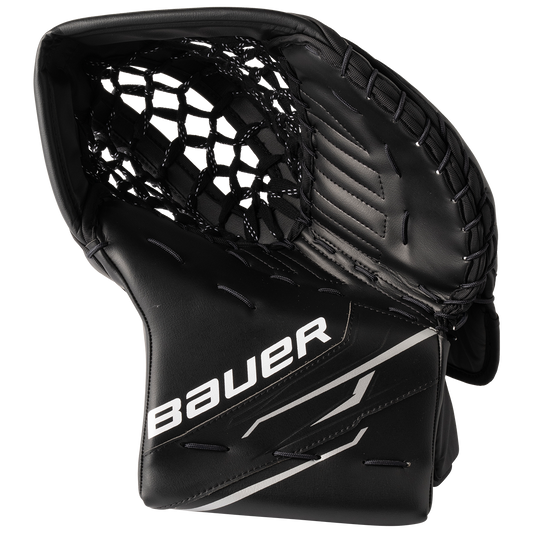
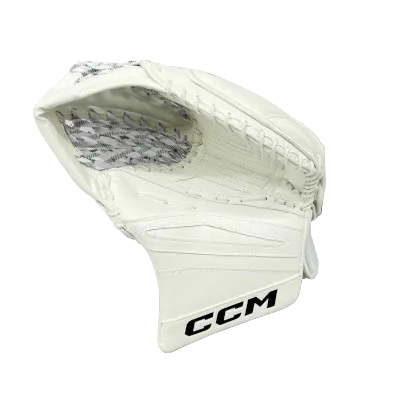
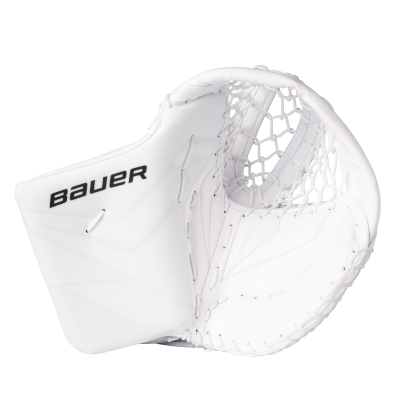
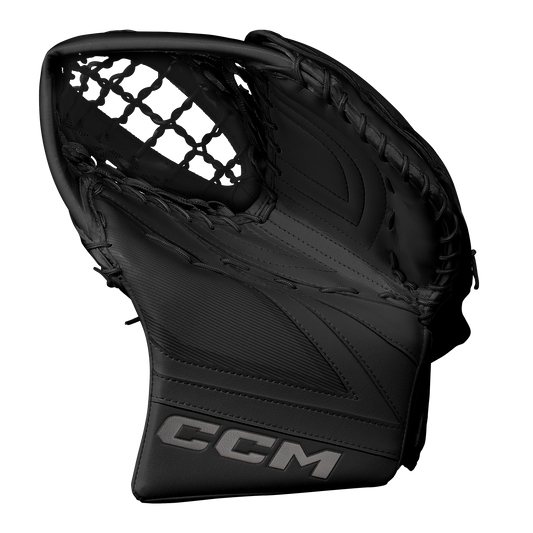
Intermediate Goalie Catchers for Growing and Smaller Goalies
Intermediate goalie catchers bridge the gap between junior and senior gloves. They provide more catching coverage and protection than junior equipment while using smaller internal hand dimensions than most senior catchers.
Intermediate gloves are commonly used by teenage goalies and growing competitive players, but they can also be the correct choice for smaller adults. A secure intermediate palm often provides better control than a senior glove that rotates or moves around the hand.
Depending on current inventory, this collection may include:
- Bauer SV-PRO Intermediate catcher
- Bauer SV-90 Intermediate catcher
- Bauer Vapor FLYLITE Intermediate Pro catcher
- Bauer S26 GSX Intermediate catcher
- Bauer S23 GSX Intermediate catcher
- TRUE Catalyst 7X6 Intermediate catcher
- Warrior G7 Intermediate Pro catcher
- CCM EFLEX 7.9 Intermediate catcher
- CCM TACKS Intermediate catcher
- CCM Axis F9 Intermediate catcher
- Matching intermediate catcher-and-blocker sets
Product availability, colours and regular or full-right orientation can change as equipment is sold. Some previous-generation listings may remain visible after individual variants sell out.
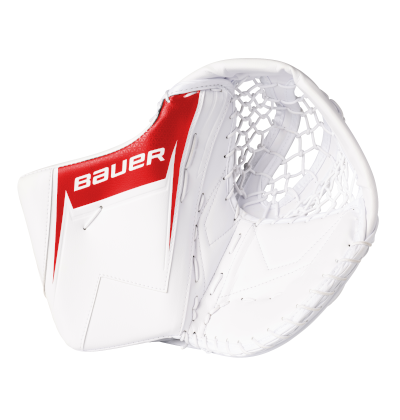
Bauer Intermediate Goalie Catchers
Bauer offers several different catcher shapes within intermediate sizing. Current options range from the value-focused GSX to performance-oriented SV-PRO, SV-90 and Vapor FLYLITE models.
The most important difference between Bauer catchers is not simply price. Closure direction, glove shape, pocket construction and cuff mobility can all change how naturally a catcher works with the goalie’s hand.
Bauer SV-PRO Intermediate Catcher
The
Bauer SV-PRO Intermediate catcher
combines design elements associated with Bauer’s Supreme and Vapor equipment.
Its stock 60-degree break creates a 590-style closure from the fingertips toward the middle of the thumb. This provides a full-hand closing motion and a rounded catching presentation.
A fused double-T pocket is designed to create a broad catching area and help retain the puck. The pocket is larger than the previous Bauer design, adding coverage without requiring a senior-sized internal palm.
Catchlite materials through the palm and pocket support easier closure, while a polycarbonate palm insert and protective foam help manage impacts.
Other SV-PRO features include:
- 60-degree, 590-style catcher break
- Fused double-T pocket
- Skate-lace pocket construction
- CURV-reinforced cuff
- Protective palm insert and foam package
- High-tack Nash palm lining
- Lightweight, flexible backhand protection
- Intermediate internal hand dimensions
The SV-PRO may suit competitive intermediate goalies who prefer a traditional rounded closure, secure palm fit and deep double-T pocket.
Bauer SV-90 Intermediate Catcher
The
Bauer SV-90 Intermediate catcher
is the alternative break option within Bauer’s SV family.
While the standard SV-PRO uses a 590-style closure, the SV-90 is intended for goalies who prefer a 580-inspired glove shape and a deeper fingers-to-palm closing motion.
A 580-style catcher can feel noticeably different from a 590. The internal hand position, thumb angle and direction of closure should be tested rather than selected solely because the glove is considered a specialized option.
The SV-90 may suit experienced intermediate goalies who already know they prefer a lower, fingers-to-palm closure. It may also be available through Bauer’s custom program when stocked colours are unavailable.
Bauer Vapor FLYLITE Intermediate Pro Catcher
The
Bauer Vapor FLYLITE Intermediate Pro catcher
is designed around mobility, fast glove presentation and a large catching pocket.
Its upgraded one-piece double-T construction is designed to move fluidly with the glove during opening and closure. The pocket is larger than the previous Vapor generation, providing additional coverage for reacting to shots around the edge of the catcher.
CURV reinforcement around the perimeter helps the glove maintain its structure. The mobile Vapor design may suit goalies who prefer an active catcher that can be quickly repositioned.
The FLYLITE may be appropriate for competitive intermediate goalies who prioritize:
- Quick glove movement
- A large catching pocket
- One-piece double-T construction
- Structural perimeter reinforcement
- Performance-level protection
- Intermediate palm and finger dimensions
The largest pocket is not automatically the best catcher for every goalie. The internal closure still needs to match the goalie’s natural hand movement.
Bauer S26 GSX Intermediate Catcher
The
Bauer S26 GSX Intermediate catcher
is designed for recreational and developing goalies looking for comfortable closure and dependable coverage.
It uses a finger-to-thumb closing direction and Supreme-inspired coverage. A fused double-T pocket provides a deep catching area, while the Free-Flex cuff helps preserve wrist movement.
An adjustable backhand and wrist strap allow the fit to be personalized. Reinforced palm protection helps absorb puck impacts, and the Nash Grip lining creates a secure internal feel.
S26 GSX features include:
- Finger-to-thumb closure
- Fused double-T pocket
- Supreme-inspired coverage
- Free-Flex cuff
- Adjustable backhand wrist strap
- Reinforced palm protection
- Nash Grip internal palm lining
The S26 GSX may be a strong choice for house-league, recreational and developing intermediate goalies who want straightforward fit and closure at a lower price than Bauer’s Pro models.
Bauer S23 GSX Intermediate Catcher
The
Bauer S23 GSX Intermediate catcher
is the previous GSX generation and may remain available in selected colours at clearance pricing.
It uses a Supreme-style finger-to-thumb closure, a deep T-trap with skate lace and rebound-control foam through the palm.
A Supreme range-of-motion wrist strap and lower adjustable strap help secure the glove while allowing movement. The Hypersense liner and overlapping pinky stall are designed to improve comfort and hand control.
The S23 GSX may offer excellent value for a developing goalie whose hand fits securely. A previous-generation glove that closes comfortably can be a better choice than a newer catcher that does not match the goalie’s hand.
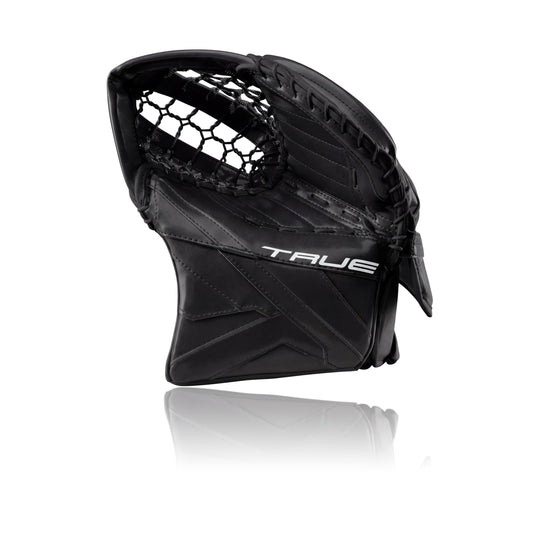
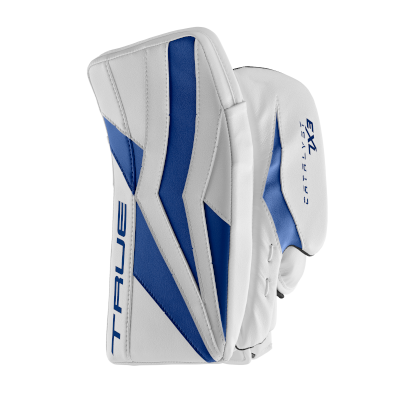
TRUE Catalyst 7X6 Intermediate Catcher
The
TRUE Catalyst 7X6 Intermediate catcher
brings TRUE and Lefevre-style catcher construction into dimensions designed for intermediate hands.
The stock 7X6 uses a 590 break that creates a rounded catching presentation. A Suregrip palm helps maintain a secure internal connection, while the double-T skate-lace pocket provides a deep receiving area.
Key features include:
- 590 catcher break
- Rounded catching surface
- Intermediate internal hand dimensions
- Suregrip palm material
- Double-T pocket
- Skate-lace pocket construction
- Regular and selected full-right options
The TRUE 7X6 may suit competitive teenage goalies and smaller adults who prefer a 590-style closure but cannot securely control a senior TRUE catcher.
Intermediate sizing affects the internal palm and finger dimensions. It can provide considerably better control than a senior glove that feels loose or rotates during saves.
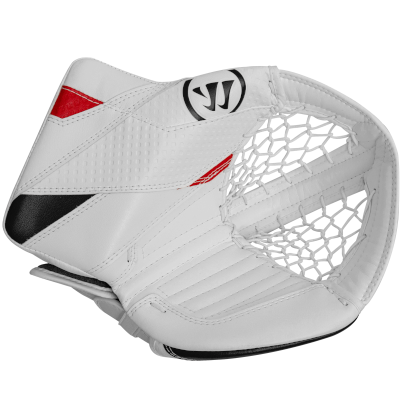
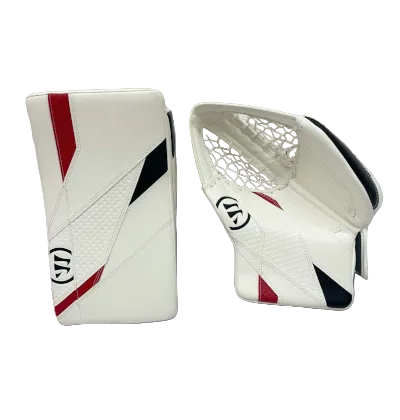
Warrior G7 Intermediate Pro Catcher
The
Warrior G7 Intermediate Pro catcher
uses Warrior’s wider G7 catching shape and an index-to-mid-thumb closure.
A removable 75-degree palm allows the internal hand component to be adjusted or replaced separately from the external catcher shell. This can help refine fit and extend the useful life of the glove when compatible palms are available.
HyperComp reinforcement helps the glove maintain its shape. A single-T pocket with Warrior’s AxyFlex T construction supports quick closure around the puck.
CoverEDGE+ increases the presented perimeter of the glove. The combination of broad shape and removable palm can appeal to goalies who want adjustability and a wide catching surface.
G7 Intermediate Pro features include:
- Wider G7 catching shape
- Index-to-mid-thumb closure
- Removable 75-degree palm
- HyperComp-reinforced core
- Single-T pocket
- AxyFlex T construction
- CoverEDGE+ perimeter design
The Warrior G7 may suit competitive intermediate goalies who prefer a wide glove shape, removable palm system and responsive single-T pocket.
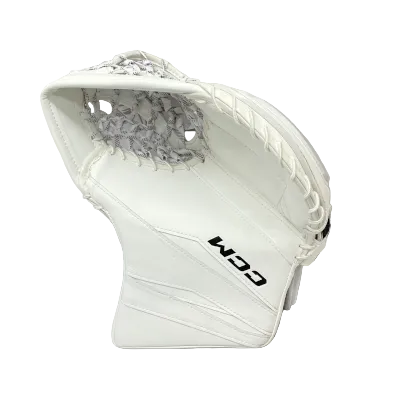
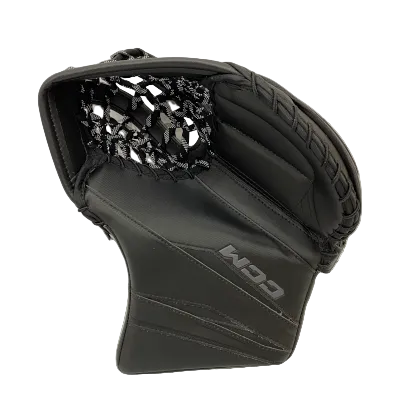
CCM EFLEX 7.9 Intermediate Catcher
The
CCM EFLEX 7.9 Intermediate catcher
uses a 580 catcher shape designed for a fingers-to-palm closure.
The 580 break provides a noticeably different hand angle from the more common 590-style catchers in this collection. It may suit goalies who prefer a lower thumb position and a deep palm-closing motion.
A single-T pocket with an additional inch of depth creates a deep receiving area. Skate-lace construction helps cushion the puck and support retention.
CCM’s CrossForm strap and internal fit system help secure the back of the hand while preserving wrist movement. FlexMotion segmentation through the backhand supports opening and closure.
EFLEX 7.9 features include:
- 580 catcher shape
- Fingers-to-palm closure
- Game-ready feel
- Single-T plus-one-inch pocket
- Skate-lace pocket construction
- Lightweight LITECORE cuff and thumb
- CrossForm hand-security system
- FlexMotion backhand
The EFLEX 7.9 may suit competitive intermediate goalies who specifically prefer a 580-style closure and deep single-T pocket.
CCM TACKS Intermediate Catcher
The
CCM TACKS Intermediate catcher
uses a 590 break intended to provide natural positioning and quick closure.
Its deep VORTX pocket uses an updated double-T shape to help secure pucks. The palm break and internal core are designed to support smooth opening and closing without requiring excessive hand strength.
A lightweight cuff and FlexMotion construction preserve wrist mobility, allowing the goalie to adjust glove presentation and react to changing shot angles.
The CCM TACKS may suit intermediate goalies who want:
- A 590-style closure
- A deep double-T pocket
- Quick, game-ready closing feel
- Lightweight cuff construction
- FlexMotion wrist mobility
- Current CCM TACKS graphics
CCM Axis F9 Intermediate Catcher
The
CCM Axis F9 Intermediate catcher
is a previous-generation CCM model that may remain available at reduced pricing.
It uses CCM’s 591 break, which is based on a 590-style shape with modifications intended to improve closure and responsiveness.
A double-T skate-lace pocket creates a broad catching area. The CrossForm strap secures the back of the hand, while FlexMotion components provide movement through the cuff and backhand.
The Axis F9 also includes a textured Suregrip palm and heat-activated fit materials around the fingers.
The F9 may be a strong clearance option for a goalie who prefers a 590-style catcher and whose hand fits the available intermediate palm.
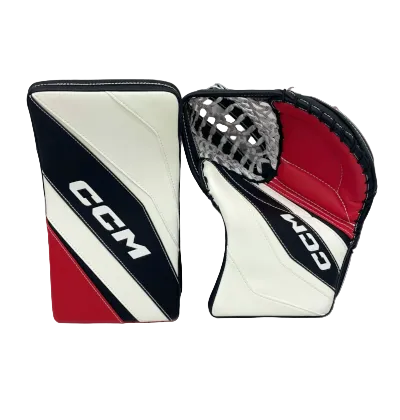
Intermediate Catcher and Blocker Sets
This collection includes several catcher-and-blocker combinations. A set can provide matching graphics and a lower combined price than purchasing both gloves individually.
Depending on availability, sets may include:
Both gloves must still fit correctly. A matching set is not automatically appropriate simply because the catcher and blocker use the same listed size.
Some goalies fit an intermediate catcher but prefer a senior blocker palm. Others may use an intermediate blocker and a different catcher size. Each hand should be fitted independently.
What Is an Intermediate Goalie Catcher?
An intermediate catcher generally provides:
- Smaller internal palm dimensions than senior equipment
- Shorter finger stalls
- A tighter wrist and backhand adjustment range
- More external coverage than most junior gloves
- Protection suitable for developing competitive goalies
- Many of the same break and pocket options as senior models
Intermediate sizing should not be considered a lower skill level. It is simply the correct physical size for goalies whose hands do not securely fill senior equipment.
How Should an Intermediate Catcher Fit?
The goalie’s hand should remain secure inside the glove without excessive movement. The fingers and thumb should reach their intended positions, and the catcher should follow the hand during opening, closure and glove presentation.
During fitting, check that:
- The fingertips reach the ends of the finger stalls
- The fingers are not painfully compressed
- The thumb remains securely positioned
- The backhand and wrist straps can hold the glove comfortably
- The catcher does not rotate around the hand
- The goalie can fully open and close the glove
- The break follows the goalie’s natural hand movement
- The cuff allows comfortable wrist movement
- The catcher does not bind against the chest protector sleeve
A catcher that is too large can feel heavy, rotate on the hand and remain difficult to close. A glove that is too small may compress the fingers and prevent the palm from sitting behind the intended protection.
Intermediate vs. Senior Goalie Catchers
The most important difference is the internal hand fit. Senior catchers generally use longer finger stalls, larger palms and wider internal dimensions.
A goalie may need an intermediate catcher when:
- The hand moves inside a senior glove
- The fingers do not reach their intended positions
- The catcher rotates during saves
- The goalie must overtighten every strap
- The senior glove feels difficult to open or present
- Hand control improves noticeably in intermediate equipment
A smaller adult should not use a loose senior glove simply because senior equipment is considered the adult category.
Intermediate vs. Junior Goalie Catchers
Intermediate catchers provide additional hand room and external coverage compared with junior models. They may also use higher-level palm protection, core materials and adjustment systems.
A goalie may be ready to move from junior to intermediate when:
- The fingers are compressed inside the junior glove
- The thumb no longer fits correctly
- The hand has outgrown the backhand adjustment range
- The external glove appears too small for the goalie
- The goalie faces shots requiring more substantial protection
- The intermediate catcher can be fully controlled and closed
Moving into intermediate equipment too early can make the catcher feel heavy and difficult to operate.
Comparing 580, 590 and 591 Catcher Breaks
Catcher break describes the glove’s internal hand angle and closing direction. It should not be treated as a ranking or protection level.
580-Style Catchers
A 580-style catcher closes from the fingers toward the palm and lower thumb area. It creates a distinctive hand position that many goalies specifically seek.
Intermediate 580-style options in this collection may include the CCM EFLEX 7.9 and Bauer SV-90.
590-Style Catchers
A 590-style catcher generally closes from the fingertips toward the middle of the thumb. It creates a rounded catching presentation and is represented across several brands.
Examples may include the Bauer SV-PRO, TRUE Catalyst 7X6 and CCM TACKS.
CCM 591 Catcher
CCM’s 591 used on the Axis F9 is based on the 590 concept but includes changes to the palm, backhand and break intended to create a different closing feel.
Break numbers are useful comparison tools, but glove feel still varies by manufacturer. A Bauer 590-style catcher will not necessarily feel identical to a TRUE or CCM 590.
Single-T vs. Double-T Catcher Pockets
The pocket’s T construction affects depth, structure and how the puck feels when it enters the glove.
Single-T Pocket
A single-T uses one central support through the pocket. It can create a defined catching channel and responsive pocket feel.
The Warrior G7 and CCM EFLEX 7.9 are examples of intermediate catchers using single-T designs.
Double-T Pocket
A double-T uses two supports to create a wider catching area. Many goalies prefer a double-T for its depth and ability to cushion the puck.
Double-T options include the Bauer SV-PRO, Vapor FLYLITE, S26 GSX, TRUE Catalyst 7X6, CCM TACKS and CCM Axis F9.
Pocket type should be considered together with catcher break and palm fit. A deep pocket cannot correct a glove that does not close naturally.
Skate-Lace Catcher Pockets
Many intermediate catchers use skate lace through the pocket. Skate lace creates a softer receiving surface than some more rigid pocket materials.
A softer pocket can help cushion impact and reduce immediate puck bounce. Pocket depth, glove presentation and catching technique also affect retention.
Inspect the pocket lace regularly for cuts, loose knots and worn sections. Damaged lacing should be repaired before a larger pocket failure develops.
Game-Ready Feel and Catcher Protection
Some catchers are designed to close easily out of the box, while others use additional palm protection and require more break-in.
A softer-feeling glove may be easier to close, but the palm protection must still be appropriate for the shots being faced.
Consider:
- Age and strength of opposing shooters
- Recreational or competitive use
- Frequency of practices and games
- Whether shots are regularly felt through the palm
- How much break-in the goalie is comfortable completing
- Whether additional palm protection is offered
Cuff Mobility and Chest Protector Compatibility
The catcher cuff should overlap comfortably with the chest protector sleeve without locking the wrist or pushing the glove away from its natural position.
The goalie should be able to:
- Present the glove toward the puck
- Rotate the palm upward and outward
- Reach across the body
- Bring the catcher toward the blocker
- Cover loose pucks
- Move without the chest protector forcing the glove downward
Browse our
intermediate goalie chest protectors
to compare compatible upper-body protection.
Regular and Full-Right Intermediate Catchers
Intermediate catchers may be available in regular and full-right orientations.
A regular goalie wears the catcher on the left hand and blocker on the right. A full-right goalie wears the catcher on the right hand and blocker on the left.
Always confirm orientation before ordering. Full-right availability may be more limited in certain models, colours and clearance products.
Breaking In an Intermediate Goalie Catcher
A new catcher may become easier to operate as the palm, break and pocket begin moving with the goalie’s hand.
Safer break-in methods include:
- Repeatedly opening and closing the glove by hand
- Securing the glove closed for short periods
- Working the intended break rather than twisting the cuff
- Using the catcher during controlled practices
- Following manufacturer and retailer instructions
Avoid ovens, boiling water and uncontrolled high heat. Excessive temperature can damage foams, plastics, adhesives and synthetic materials.
Current and Previous-Generation Catchers
This collection contains current models and previous-generation equipment offered at reduced prices.
Clearance catchers can provide excellent value when:
- The palm fits securely
- The catcher break suits the goalie
- The glove provides suitable protection
- The correct orientation is available
- The colour and selected variant are correct
- The applicable return or final-sale conditions are understood
A discounted previous-generation glove that fits correctly is generally a better choice than a current premium model that does not match the goalie’s hand.
Caring for an Intermediate Goalie Catcher
Remove the catcher from the equipment bag after every practice and game. Open the glove and loosen the wrist and backhand straps so the palm, pocket and internal materials can dry completely.
Inspect the catcher regularly for:
- Loose or damaged pocket lace
- Worn binding or perimeter materials
- Damaged finger stalls
- Stretched wrist and backhand straps
- Compressed palm protection
- Cracked or distorted internal components
- Changes in closure or hand fit
Avoid excessive heat during drying. High temperatures can damage foams, plastics, adhesives and synthetic materials.
When Should an Intermediate Catcher Be Replaced?
A catcher may need replacement when it no longer protects the hand, remains securely positioned or maintains its intended structure.
Warning signs include:
- Shots are regularly felt painfully through the palm
- The glove no longer fits securely
- The catcher will not remain properly open or closed
- The pocket or T structure is damaged
- The internal core has cracked or lost its shape
- Important straps cannot be repaired securely
- A growing goalie no longer fits the palm
Choosing the Right Intermediate Goalie Catcher
When comparing intermediate goalie catchers, consider:
- Hand length, width and finger position
- Intermediate or senior internal palm fit
- 580, 590, 591 or other closure style
- Single-T or double-T pocket
- Skate-lace pocket construction
- Game-ready feel and palm protection
- Cuff and wrist mobility
- Regular or full-right orientation
- Playing level and shot exposure
- Compatibility with the chest protector sleeve
- Current-generation or clearance pricing
The right catcher is the glove that fits securely and follows the goalie’s natural closing motion. Brand, graphics and price should come after fit, comfort and protection.
Complete an Intermediate Goalie Setup
Complete the setup with properly fitted:
You can also browse our complete
goalie catcher collection
or compare
junior
and
senior
catcher options.
Shop Intermediate Goalie Catchers Across North America
The Goalie Crease is a goalie-only specialty retailer serving goalies throughout Canada and the United States. Our team understands how catcher break, palm size, pocket construction and wrist mobility affect growing goalies, teenagers and smaller adults.
Shop intermediate goalie catchers online across North America or visit our 4,000+ square foot goalie-only showroom in Richmond Hill, Ontario. Our goalie equipment experts can help you compare Bauer, CCM, TRUE and Warrior models and choose a catcher suited to your hand size, playing level and preferred closure.